

Dr. Suver discussed the relationship between the Belt and Road Initiative, the Middle Corridor, and Turkey.
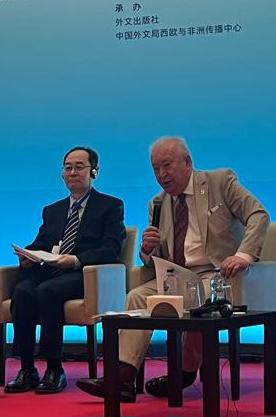
Dr. Akkan Suver, President of the Marmara Group Foundation, spoke at a ceremony held at the InterContinental Hotel in Ankara by H E. Jiang Xuebin, the Ambassador of the People's Republic of China to Ankara, on the occasion of the launch of (President H. E. Xi Jinping's book.)
In his speech, Dr. Akkan Suver highlighted the connection between the Belt and Road Initiative and the Middle Corridor, as well as Turkey's role and significance in this context.
The text of Dr. Akkan Suver's speech is as follows:
Dr. Akkan Suver’s Speech at the Book Launch Ceremony for “Xi Jinping: The Governance of China”
July 1 2026 – Ankara
First of all, on behalf of myself and the Marmara Group Foundation, I respectfully greet your distinguished assembly.
Before I begin my remarks, I would like to mention two significant anniversaries here today.
Today, as we mark two significant anniversaries and witness the unveiling of a new work, I would like to take your distinguished delegation back 105 years.
105 years ago today, on July 1, 1921, the Communist Party of China was founded by Mao Zedong, Zhou Enlai, Chen Duxiu, and their comrades. The foundations of today’s People’s Republic of China were laid on that day.
Fast-forwarding from those days to August 4, 1971, Hasan Esat Işık, Türkiye’s Ambassador to Paris, and Huang Zen, the People’s Republic of China’s Ambassador to Paris, signed the agreement establishing the official diplomatic relations that have made our gathering here today possible.
In light of these two significant dates, we are also witnessing the book launch of Xi Jinping, President of the People’s Republic of China, here today.
After sharing these three beautiful and exceptional coincidences with you, I would like to discuss a new founding axis—or center—that is emerging within Eurasia’s new balance of power.
This emerging new founding axis is a component of both the Middle Corridor Route and the Belt and Road Initiative.
Ever since it was proposed by H.E. Xi Jinping, President of the People’s Republic of China, the Belt and Road Initiative—which we at the Marmara Group Foundation, under my leadership, have brought to the forefront on countless national and international platforms in our capacity as a civil society organization—we view it not merely as a trade initiative but primarily as a peace project. Therefore, I find it worthwhile to note here today that this new center is an expanded peace project in which the Middle Corridor Route and the Belt and Road Initiative complement one another.
Consequently, when viewed as a peace project, the Middle Corridor Route will create a strong and balanced Asian landscape that facilitates Eurasian integration and will accelerate the development and growth of the countries it encompasses.
Indeed, under the guidance of the Belt and Road Initiative, the countries comprising the Middle Corridor Route will unite a region characterized by diverse economies, actors, cultures, languages, religions, and interests, thereby enabling Eurasian countries to get to know one another—and European countries more closely.
In light of these considerations, the Middle Corridor Route which is closely associated with the Belt and Road Initiative, which serves the cause of peace is today a faster, more economical, and safer route not only compared to the Northern Corridor but also compared to other alternatives.
As you know, the ongoing Russia–Ukraine war in the Northern Corridor is creating an environment of insecurity, political risk, and sanctions.
Meanwhile, the Strait of Hormuz crisis is obstructing shipping routes in the Red Sea.
As for the Houthi militias in Yemen, they, too, pose a separate threat to commercial vessels.
Based on the data I have presented, I can say that the Middle Corridor Route is currently the only viable and secure route for trade and transportation.
Consequently, the Middle Corridor Route will not only facilitate the integration of Eurasia but also create a strong and balanced Asian landscape and establish the safest and shortest route connecting Europe and China.
This route will also pave the way for multilateral cooperation between China, the European Union, the Middle East, and other actors.
In this way, the philosophy of the Belt and Road Initiative will come to life through a more seamless collaboration.
If we were to summarize the impact of this new hub on each country in a single sentence, the People’s Republic of China’s route to Europe will be shortened by approximately 2,000 kilometers.
As for Kazakhstan, as a key transit point, it will facilitate not only the transport of commercial goods but also the access of the country’s oil and energy resources to markets.
Landlocked Kyrgyzstan, meanwhile, will achieve seamless logistical and trade integration with global markets by utilizing this route.
From Uzbekistan’s perspective, the Middle Corridor will provide direct access to global markets and ensure a reduction in its dependence on traditional northern routes.
The Lapis-Lazuli transit corridor project in Turkmenistan, meanwhile, will serve as an alternative initiative for the Middle Corridor Route.
Azerbaijan, as the strategic backbone of the Middle Corridor Route, serves as a key transit point connecting China and Central Asia to Europe via the Caucasus.
Georgia, meanwhile, is a region enriched by the infrastructure projects of the Middle Corridor. This project represents a major strategic opportunity for Georgia.
In summary, the strong cooperation and shared vision among Turkey, Georgia, and Azerbaijan also serve as the Middle Corridor Route’s gateway to Europe.
Moreover, Turkey is a country that has fulfilled the requirements for establishing the Belt and Road Initiative over the past few years.
All these exceptional partnerships serve as strong evidence that the Belt and Road Initiative and the Middle Corridor Route will together chart a roadmap for lasting peace.
As I conclude my remarks, I would like to share with your delegation that the Belt and Road is now digital. It is communication. It is interaction.
Based on the fact that yesterday’s Silk Road has now been transformed into a digital realm, I believe that when the necessary political, economic, and cultural dialogues are established, we will have a more peaceful, more prosperous, and safer world.
As I conclude my remarks, I would like to emphasize that Turkey is the key hub of the Eurasian segment of the Belt and Road Initiative. Turkey has adopted the Middle Corridor Route as a strategic transportation route that it developed on its own initiative. Therefore, Turkey is ready to serve as the most reliable bridge between the Belt and Road Initiative and Europe.