

Dr. Akkan Suver Spoke at the “Western Azerbaijan” Conference
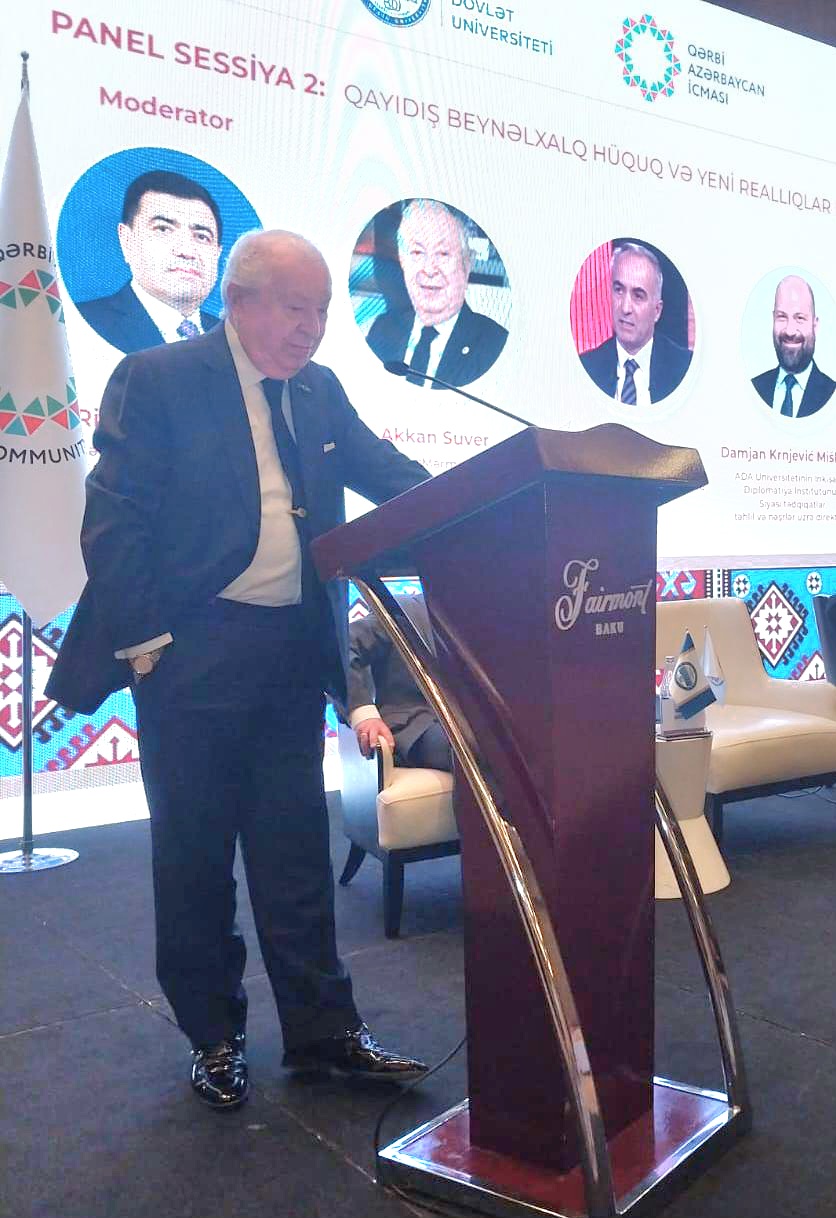
Dr. Akkan Suver, President of the Marmara Group Foundation, delivered a speech at the “Western Azerbaijan” Conference, which he attended together with the Foundation’s Secretary General, Sezgin Bilgiç.
You will find the text of Dr. Akkan Suver’s speech below:
The Restoration of the Rights Taken Away from Western Azerbaijanis
Dear Friends,
First of all, I would like to begin my remarks by respectfully greeting your distinguished delegation on behalf of myself and the Marmara Group Foundation.
As you are well aware, the relations between Türkiye and Azerbaijan are not merely a cultural interest or a nostalgic bond.
As a person conscious of the responsibility that rests upon him, I would like to state here that the issue of Western Azerbaijan is regarded in Türkiye as a historical matter.
As we all know, these lands, which had been Turkified since the Seljuk period, passed into Armenian hands during the era of the Soviet Union.
Until a hundred years ago, the rich cultural heritage, historical monuments, mosques, and cemeteries of the Azerbaijanis who lived in Western Azerbaijan with their cultural, religious, linguistic, and political identities no longer exist today.
As a result of a long-term, deliberate, and systematic policy of assimilation, Armenians have created a fictitious Armenia through the changing of place names, rivers, lakes, and mountains in Western Azerbaijan.
In this Armenia that has been created, if Lake Göyce has become Sevan, the Zengi River has become Hrazdan, and Mount Alagöz has become Aragats, this is a crude example of Armenian chauvinism.
Likewise, the renaming of Allahverdi district as Tumanyan, Hamamlı district as Spitak, and the alteration of 717 regional-administrative divisions bearing Turkish names are further examples of this chauvinistic and destructive approach.
While the names were being changed, what was imposed upon the people living there?
What was imposed upon them was exile.
The traces belonging to Azerbaijan were erased, and as a result of the cleansing policies implemented and the transfer of Zangezur to Armenia, the land connection between Nakhchivan—an inseparable part of Azerbaijan—and the mainland was cut off, and an attempt was made to rewrite the history of the region.
Let us pause here for a moment:These are facts known by all of us.
The organization of meetings concerning Western Azerbaijan is good, necessary, and appropriate.
But it is not sufficient.
So, what should we do today?
First of all, we must ensure that the issue of Western Azerbaijan is discussed on the international agenda. Meetings should be organized by non-governmental organizations carefully, diligently, and in accordance with legal norms, and the issue should be raised tirelessly and patiently, day and night, in the world's major centers.
Initiatives should be undertaken before UNESCO concerning the historical heritage, and if any monuments remain, or whatever remains, their preservation should first be ensured.
I would also like to emphasize the necessity of making initiatives before the United Nations and keeping this issue continuously on the agenda until the day comes when the right to live in their own homeland, in a manner compatible with human rights, is secured.
It is essential that our rightful claims be defended with documents in international panels and human rights organizations.
We must explain the justice of our cause at every opportunity through social actions as well as on academic and diplomatic platforms.
At the same time, social media should not be neglected.
The literary and artistic values of the region should also be kept on the agenda through events to be organized in major centers around the world in order to preserve its cultural heritage.
Young people studying abroad should even be encouraged to organize activities introducing and explaining the region to their foreign friends.
We are obliged to do these things for our Western Azerbaijani brothers and sisters in the name of the right to live as human beings.
And above all, we must ensure the safe and dignified return of the people of these lands to their ancestral homeland through peaceful means.
If lasting peace is desired in the region, the Republic of Armenia is obliged to grant and guarantee Western Azerbaijanis the right to live there in a humane manner.
These are facts known by all of us.
Let us not forget that seeking one's rights is a freedom.
In other words, the effort to find justice, obtain what rightfully belongs to oneself, and remedy injustice is the most civilized method.
This is how we should approach the matter.
My proposal is that appeals be made under the United Nations mechanisms concerning the rights of persons belonging to national, ethnic, religious, and linguistic groups, as well as on the basis of the agreements on the protection of the owners of the land contained in the two framework conventions of the Council of Europe and the Copenhagen Document of the OSCE.
At the same time, while seeking these rights, it is important to emphasize that the rights being sought are rights that already exist.
This is also a moral right.
If I were to resort to a little rhetoric, I would say: The Armenian lies.
It does not believe historians or archives. It never refrains from involving third parties. It does not incline toward reason.
Therefore, what falls upon us is not to keep this issue away from international platforms.
I believe that both we and the Armenian side are obliged to achieve this not through fire and suffering as they did yesterday, but as the realization of a human right.
The return of Azerbaijanis to their ancestral lands is a right.
According to international norms, it is a requirement of law and justice.
When viewed from an ethical perspective, its denial constitutes an international disgrace.
If one resorts to moral criteria, words become insufficient.
Therefore, I regard the protection, preservation, and defense of this right, law, justice, ethics, and moral values as a duty to humanity.
Discussing, debating, and keeping this issue on the agenda is important and necessary both for cultural heritage and for raising international awareness.
In summary, we must explain the reality of Western Azerbaijan to more people and more institutions.
Dr. Akkan Suver
President
Marmara Group Foundation for Strategic and Social Research
.jpg)