1 March 2019
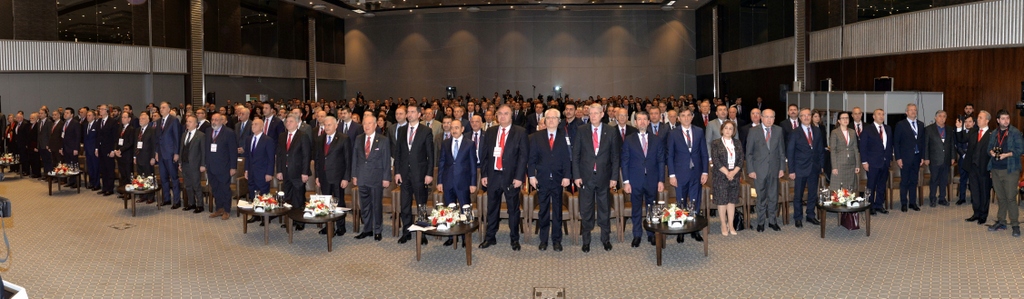
The 22nd Eurasian Economic Summit opened with the participation of Speaker of the Grand National Assembly of Türkiye Binali Yıldırım. Opening the Summit, Marmara Group Foundation President Dr. Akkan Suver said that the Eurasian Economic Summits had become a tradition.
CLICK HERE FOR THE SUMMARY OF THE 22ND EURASIAN ECONOMIC SUMMIT
Messages were sent to the Summit by President of Azerbaijan Ilham Aliyev, President of Montenegro Milo Đukanović, President of the Turkish Republic of Northern Cyprus Mustafa Akıncı and Chairman of the Council of Ministers of Bosnia and Herzegovina Denis Zvizdić. İHKİB President Mustafa Gültepe and OSBÜK President Memiş Kütükcü also addressed the opening and delivered messages in support of a strong Türkiye.
Dr. Akkan Suver noted that the Marmara Group Foundation had organised the Summit continuously for twenty-two years and that the event had now become an established tradition.
He said that, under the conditions of the day, the Summit offered an important opportunity for Türkiye and provided a suitable international platform on which to explain Türkiye's struggle against terrorism.
Speaking about that struggle, Dr. Suver also stated that Türkiye would not allow faits accomplis in the Black Sea or the Mediterranean.
He added that the Foundation had always supported the European Union, which it regarded as a culture of stability, prosperity and peace.
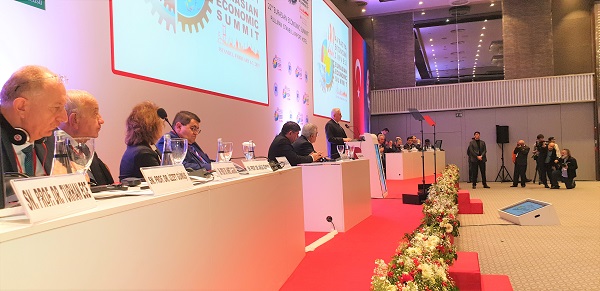
In his address to the 22nd Eurasian Economic Summit, Speaker of the Grand National Assembly of Türkiye Binali Yıldırım said: “The way to resolve migration and refugee issues is not to build higher walls, but to eliminate injustice, poor governance and the deep inequality in income distribution around the world.”
Addressing the many Turkish and international guests attending the Summit, Yıldırım said that all efforts were intended to bring peace and stability to countries and regions. “The fact that our geography is associated with war, terrorism and violence may benefit interests in other parts of the world. We, however, must approach these matters with a focus on solutions,” he said.
Referring to conflicts and wars in the region, Yıldırım added: “When a problem arises, war and conflict should not be the first things that come to mind. The issues causing disagreement and confrontation among the countries of the region must first be addressed. It is worth noting that Eurasia is once again the region where terrorism, instability and disputes are most concentrated.”
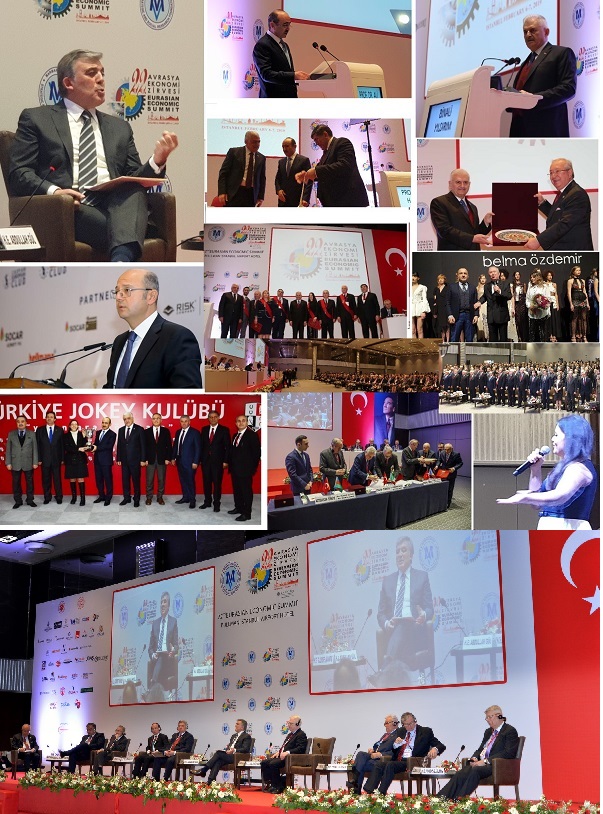
Türkiye's 11th President Abdullah Gül spoke during the session entitled “Populism”. He described populism as a widely discussed and highly topical issue that was also a cause for concern.
Gül said that the rise of populism not only weakened liberal democracy but also undermined democracy's fundamental principles and qualities. He recalled that after the end of the Cold War, the fall of the Berlin Wall in 1989 and the dissolution of the Soviet Union in 1991, democracy and freedoms spread over a much wider area. More people began to benefit from fundamental rights and freedoms, states were restructured around the rule of law and constitutions were rewritten with important reforms aimed at democratic government.
He warned, however, that during the second decade of the twenty-first century this progress had begun to reverse and populist movements had risen in many parts of the world. While many developing countries had been working to improve democratic and legal standards through far-reaching reforms, they had suddenly begun to experience regression.
WITH OUR THANKS