
Belgium’s active role in the international economy and its feature as a good transit point both physically and economically to other European countries position the country as a particularly good partner for activities planned to be carried out in Europe.
As the center of the European Union and many other international organizations, Belgium hosts a large number of personnel from these institutions, making the country an important liaison center in many sectors, including the construction sector.
Belgium, a country with high export potential, carries out re-export of many products.
It is considered that this structure may enable an increase in the export of products originating from our country.
Adding high value-added and high-yield products to the existing products exported by Turkey is effective in closing the foreign trade deficit with Belgium. Especially considering the increasing share of the service sector in Belgium’s GDP, the export of telecommunications products for use in this sector, as well as electrical and non-electrical machinery and equipment, and ready food products, can be effective in increasing our country’s export revenues.
On the other hand, auto spare parts, ready-to-wear clothing and various textile products, construction materials, and food products originating from our country continue to be attractive products in the Belgian market. Particularly, the high quality of goods and services aimed at the construction sector in Belgium can also be listed as an important factor in terms of bilateral cooperation opportunities.
A notable aspect in the construction sector is the projects carried out within the framework of economic cooperation and development programs that Belgium conducts mainly with African countries and other less developed countries. It is believed that combining Belgium’s historical ties with African countries and the experience of Turkish contracting firms in the sector will create great synergy through cooperation.
Similarly, Belgium is exploring cooperation possibilities with democracies established after the 'Arab Spring,' such as Libya. The knowledge and experience of Turkish contractors in these countries have the potential to transform into projects through partnerships.
It is considered that the approximately 200,000 Turkish citizens living in Belgium can be effective in increasing our country’s exports as well as Turkish investments in Belgium and investments in Turkey. However, the companies established by our citizens residing in Belgium are mostly small-scale enterprises.
Increasing joint investment opportunities will be effective in enhancing our country’s export potential. Due to labor costs in Belgium, industries such as textiles, iron and steel, furniture, and other labor-intensive industries tend to move out of the country.
On the other hand, there are opportunities to direct advanced agricultural technology investments to our country. Preparing suitable infrastructure for these investments in our country can create a lasting export potential for the future.
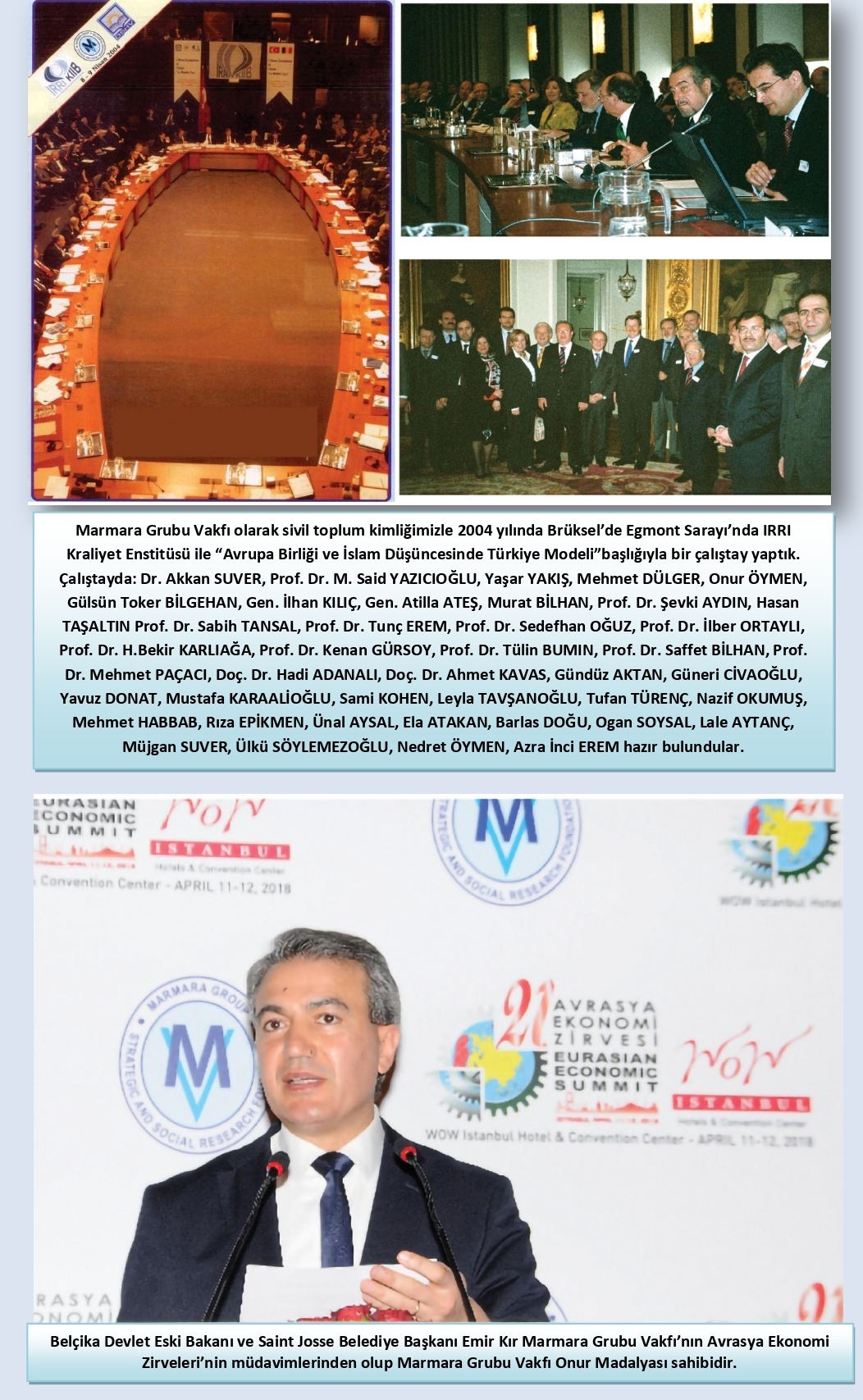
Meanwhile, the Belgian State shows great interest in the activities of the Marmara Group Foundation. The Belgian State, which occasionally participates in the Eurasian Economic Summits at the ministerial and parliamentary levels, and its civil society organizations sometimes host and often participate in the activities of the Marmara Group Foundation.
The Belgian Minister-level participation in the meeting we organized with IRRI (Royal Institute for International Relations) at the Palais d’Egmont Palace is remembered by the Marmara Group Foundation as a civil society organization. Approximately 400 people, including Belgian intellectuals, academics, and journalists, attended the workshop featuring then State Minister Prof. Dr. François-Xavier De Donnea.